Choosing good miswak sticks starts with checking what the product is, how the sticks look and feel, and whether the packaging is intact. For bulk purchases, you should also agree on the required size, acceptable condition and packaging before placing an order.
Miswak, also known as siwak, is a traditional stick used to clean the teeth. You may find it sold under names such as Peelu or Arak, depending on the market. This guide explains how to assess miswak before buying, whether you need a stick for personal use or a larger order for your business.
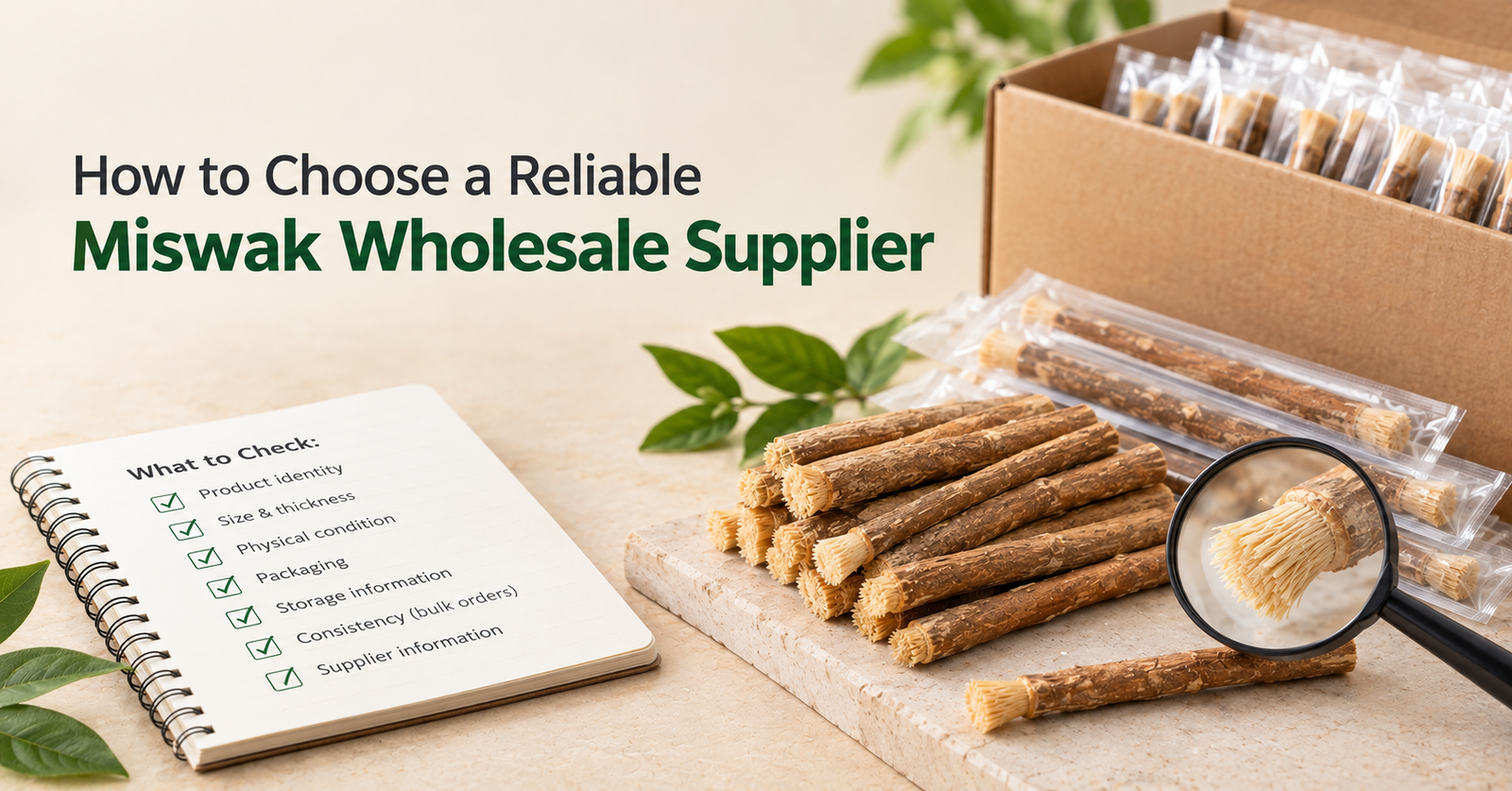
Quick Checklist: What to Look for When Buying Miswak Sticks
Use this checklist when comparing products or suppliers.
- Product identity: Look for a clear description of the miswak type and its botanical identity where available.
- Size and thickness: Choose a comfortable size for personal use. For bulk orders, agree on the required length and diameter.
- Physical condition: Check for excessive cracking, badly broken ends, visible mould or foreign material.
- Packaging: Look for intact wrappers or pouches without obvious punctures or broken seals.
- Storage information: Ask how the product should be stored and whether the supplier provides specific guidance.
- Consistency: For wholesale orders, agree on acceptable size variation, physical condition and packaging.
- Supplier information: Ask about product specifications, batch identification where available, and relevant quality records.
These checks help you make a more informed decision. Some qualities, such as precise moisture levels or microbial contamination, cannot be confirmed by appearance alone.
- Check What Type of Miswak You Are Buying
Before comparing quality, make sure you understand which product the seller is offering.
Miswak and siwak are common names for a traditional tooth-cleaning stick. “Sewak” is another spelling used in some markets. “Natural chewing stick” is a broader term, however, and can describe sticks from different plants.
The botanical name Salvadora persica is widely associated with traditional miswak. The Royal Botanic Gardens, Kew, recognises it as an accepted species and records it as native to parts of Africa and Asia, including Pakistan. You can check the Kew botanical reference.
What do Peelu and Arak mean?
Peelu and Arak are common plant names whose usage can vary by region and seller. Do not assume that every product sold under either name comes from exactly the same botanical species.
If the species matters to you, check the label or ask the supplier to confirm it. This is particularly important for wholesalers, importers and retailers who need accurate product descriptions for their own customers.
For example, Al Ghani International identifies its main product as Peelu miswak made from Salvadora persica on its wholesale miswak page.
- Check the Stick’s Size and Physical Condition
Once you know what you are buying, inspect the stick itself. Focus on its dimensions, surface condition and any visible damage.
Compare length and thickness
Miswak sticks are available in different sizes. There is no single ideal diameter or length for every buyer, so choose according to your needs and the seller’s stated specifications.
For personal use, consider whether the stick is comfortable to hold and handle. If you are ordering for a business, request the size range you need and agree on how much variation is acceptable.
Al Ghani International lists 6-inch and 8-inch options where applicable. Confirm the available size for your specific order before purchasing.
Look for visible damage
Check for:
- Deep cracks or splits along the stem.
- Severely crushed or broken ends.
- Unusual surface damage.
- Visible mould or foreign material.
A minor difference in shape or colour does not automatically mean a stick is defective. Natural plant material varies. The important question is whether the product is in an acceptable condition for its intended use and matches the seller’s description.
If a large proportion of the sticks are damaged, ask the supplier to explain the condition before you buy.
Check the product against its description
Product photographs can help, but they may not show every stick in an order. If you are buying online, look for clear images and ask for more information when the size, condition or packaging is unclear.
For commercial orders, record the expected dimensions and acceptable defects in the product specifications. This gives both parties a clear basis for checking the delivered order.
- Understand Freshness, Dryness and Storage
Miswak is natural plant material, so its condition can change with processing, handling and storage. A stick’s appearance or feel may offer clues, but no single sign proves its freshness.
Is dry miswak always poor quality?
No. Dryness alone does not mean a miswak stick is poor quality. Similarly, flexibility does not automatically prove that a stick is fresh or safe.
A very brittle stick may break easily and be less convenient to handle. However, you cannot determine the product’s full quality from brittleness alone. Colour and moisture condition can also vary between products.
Watch for signs of deterioration
Avoid using a stick that has visible mould, unexplained contamination or clear signs of deterioration. A musty or otherwise unusual smell is a reason to stop and investigate rather than assume the product is suitable.
Do not taste a questionable stick to test its quality. If you have concerns, contact the seller and share photographs of the stick and its packaging.
The absence of visible mould or an unusual smell does not guarantee that the product is free from microbial contamination.
Ask about storage
Temperature, humidity, handling and packaging can all affect the condition of natural products. Ask the supplier for storage guidance specific to the product you are buying, and follow any instructions provided.
Avoid relying on a fixed shelf-life estimate unless it is supported for that product and packaging.
- Check the Packaging Before Buying
Packaging protects miswak during handling, storage and transport. It can also help limit exposure to dust and other external material.
Inspect wrappers and seals
For individually wrapped or vacuum-sealed miswak, check for:
- Torn or punctured pouches.
- Broken or incomplete seals.
- Open packaging.
- Visible dirt or foreign material inside the pack.
- Damage that may have occurred during shipping.
If a pouch is damaged, ask the seller about it before using the stick. A compromised seal does not tell you exactly what happened, but the packaging can no longer be relied on as an intact barrier.
Does vacuum sealing guarantee freshness?
No. Vacuum packaging can help limit exposure to the surrounding environment when the pouch is properly made and remains intact. It cannot prove that the stick was fresh before sealing or that it was stored correctly throughout its journey.
For online purchases, check whether the seller shows the actual packaging as well as the sticks. For resale, confirm the packaging format, quantity per pack, labelling and outer-carton requirements before ordering.
- What Should Wholesale Buyers Check?
For a bulk order, inspecting one stick is not enough. Importers, distributors and retailers need to know whether the full shipment will meet their requirements.
Before placing an order, agree on the following details.
Product specifications
Product specifications describe what the buyer expects to receive. For miswak, these may include:
| Specification | What to agree |
| Product identity | The product name and botanical species, where confirmed |
| Size | Required length and diameter, including acceptable variation |
| Physical condition | Acceptable cracks, broken ends and other defects |
| Packaging | Individual pouches, retail packs, boxes or bulk cartons |
| Pack quantity | Number of sticks per pack or carton |
| Labelling | Product name, brand and other required information |
| Inspection | How the delivered order will be checked |
The right level of detail depends on your market and how you plan to sell the product.
Sample approval and shipment checks
If the supplier offers samples, inspect them before committing to a larger order. Compare the size, surface condition and packaging with your requirements.
A sample helps you assess the product, but it does not guarantee that every stick in a later shipment will be identical. For repeat orders, agree on the specifications in writing and discuss how the delivered goods will be checked against them.
For example, if you need sticks within a particular diameter range, specify that range rather than relying on a description such as “medium thickness.” If some natural variation is acceptable, make that clear before production or dispatch.
Batch consistency and traceability
Batch consistency means that repeat orders meet the agreed requirements as closely as reasonably expected. This matters when you need products to match existing listings, packaging and customer expectations.
Ask whether the supplier can provide batch identification or relevant handling and inspection records. Do not assume a particular traceability system exists unless the supplier confirms it.
Check export requirements early
International buyers should confirm shipping arrangements and the paperwork required for their destination market before dispatch.
Plant products may be subject to phytosanitary requirements intended to manage plant-health risks. The specific requirements depend on the commodity and importing country. Pakistan’s Department of Plant Protection export procedure explains that inspection, sampling, treatment and certification depend on the importing country’s requirements.
Do not assume that the same export documents are mandatory for every destination. Confirm the requirements with the relevant authorities or your customs agent.
- How Can You Check Miswak Quality Beyond Appearance?
Some checks can be done by looking at the product. Others require supplier information or testing.
Visual inspection: You can check the advertised product identity, dimensions, visible damage, packaging integrity and obvious foreign material. These checks help you identify problems but cannot confirm every quality or safety characteristic.
Supplier documentation: Depending on the order, ask for product specifications, confirmation of botanical identity, batch information where available, and relevant inspection or quality records.
Measurement and laboratory testing: Precise moisture levels require an appropriate measurement method. Investigating possible microbial contamination or particular chemical contaminants may require suitable laboratory testing. The right tests depend on the product and the buyer’s requirements.
A stick that looks acceptable is not automatically proven to be free from every possible contaminant. Equally, do not assume a supplier has carried out a particular test unless relevant evidence is available.
For commercial buyers, the most useful approach is to agree on product specifications first, then decide which records or tests are relevant to the order.
- Where to Buy Peelu Miswak Sticks
When choosing a supplier, look for clear product information, practical answers to your questions and the ability to discuss your required specifications.
Al Ghani International supplies Peelu miswak sticks made from Salvadora persica and serves commercial buyers, including importers, distributors, wholesalers and retailers.
You can explore the Peelu Miswak Sticks catalogue for product information. Businesses interested in larger quantities can visit the Wholesale and Bulk Miswak Orders page to discuss sizes, quantities, packaging, destination and shipping requirements.
Al Ghani International states that its minimum wholesale order quantity starts at 5,000 miswak sticks. The company also lists 6-inch and 8-inch options where applicable. Confirm the available options and current order terms directly before placing an order.
For a useful quotation, provide your required quantity, preferred size, packaging requirements and destination market. If you need custom branding or particular product specifications, include those details in your inquiry.
Frequently Asked Questions About Choosing Miswak
How can I choose good miswak sticks?
Check the product identity, size, physical condition and packaging. Look for excessive damage, visible mould or foreign material, and compare the product with the seller’s description. If you are buying in bulk, agree on specifications before ordering.
What is the difference between miswak, siwak and a chewing stick?
Miswak and siwak are common names for a traditional tooth-cleaning stick. “Chewing stick” is a broader term that can describe products from different plants. Check the botanical identity if the species matters to your purchase.
Is dry miswak always bad quality?
No. Dryness alone does not establish poor quality. Processing and storage can affect the condition of a stick, so consider the overall product condition and the supplier’s information rather than relying on moisture or flexibility alone.
Does vacuum-sealed packaging guarantee freshness?
No. An intact sealed pouch can help protect the product from external exposure, but it does not prove that the stick was fresh before packaging or stored correctly throughout transport.
What should I check before buying miswak in bulk?
Agree on product identity, size, acceptable physical condition, packaging, pack quantities and inspection requirements. If samples are available, inspect them and document the agreed specifications before placing the full order.
Can I confirm miswak safety by looking at it?
No. Visual inspection can reveal some problems, such as visible mould or damage, but it cannot rule out every possible form of contamination. Some concerns require documentation, measurement or laboratory testing.
What should I ask a miswak supplier before placing an order?
Ask which product is being supplied, what sizes and packaging are available, what quantity you can order, and which specifications and records can be confirmed. For international orders, also check shipping arrangements and destination-country requirements.
Make a More Informed Buying Decision
Good miswak purchasing starts with clear product information and realistic quality checks. Inspect the stick and its packaging, ask the supplier to confirm details you cannot verify yourself, and agree on written specifications for bulk orders.
To explore available products, visit Al Ghani International’s Peelu miswak catalogue. For commercial quantities, you can also discuss wholesale miswak requirements.